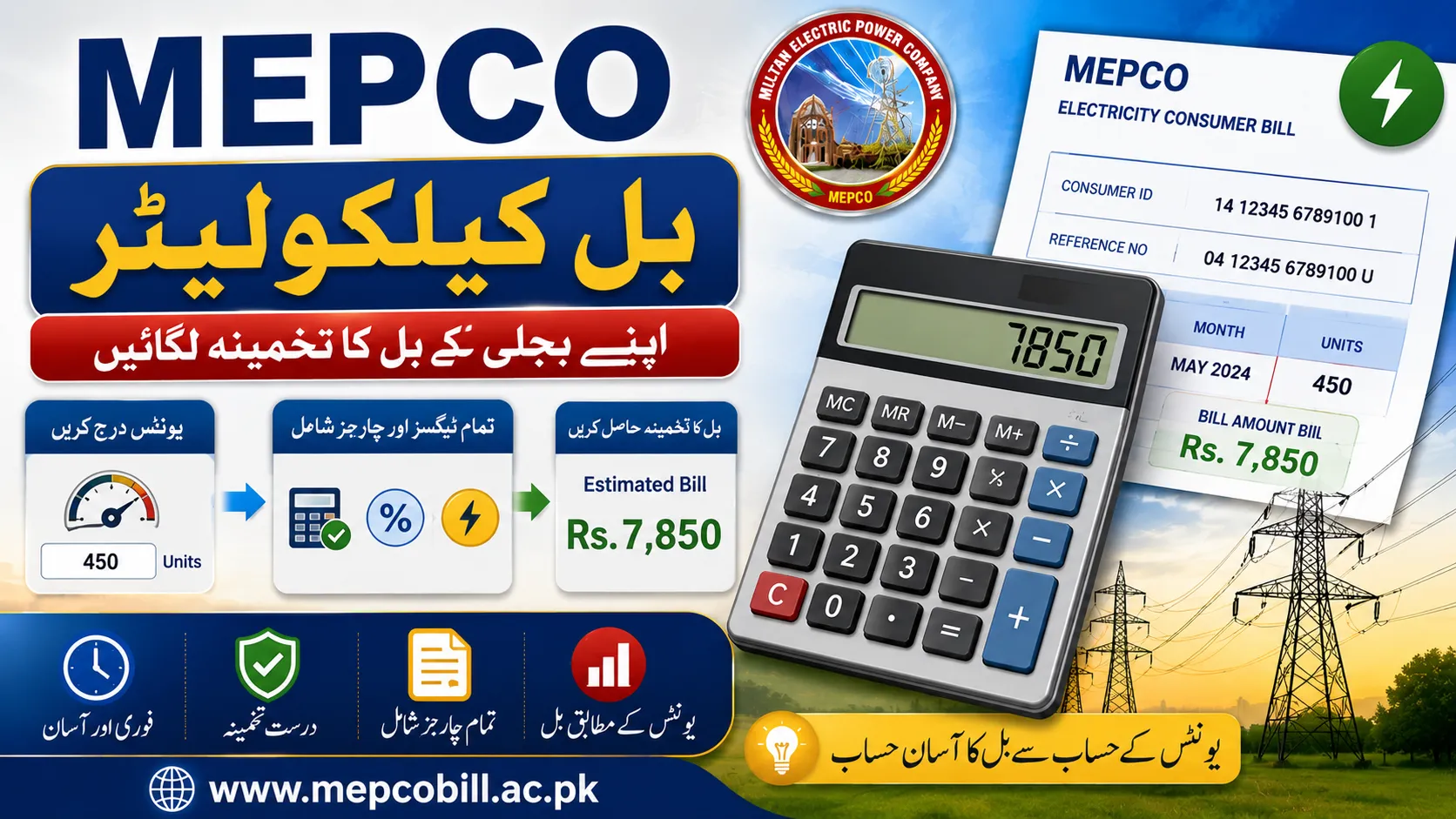
MEPCO Bill Calculator – Estimate Your Electricity Bill by Units
Estimate your MEPCO electricity bill using your monthly unit consumption. Learn how electricity bills are calculated, understand tariffs and additional charges, and use our bill calculator to plan your monthly expenses.
Calculate Your Estimated Electricity Bill in Seconds
Knowing how much your electricity bill might be before it arrives can help you plan your monthly budget and better understand your energy consumption. A bill calculator provides an estimate based on the information you enter, such as the number of electricity units consumed and, where relevant, your consumer category.
Bill Calculator
[Enter Units Consumed]
[Select Consumer Category (Optional)]
[Calculate Estimated Bill]
Estimated results are provided for informational purposes and may differ from your official electricity bill.
What Is a MEPCO Bill Calculator?
A MEPCO Bill Calculator is an online tool that estimates your electricity bill using the information you provide, such as the number of units (kilowatt-hours) consumed during a billing period. It helps consumers get a general idea of what their upcoming bill may look like before the official bill is issued.
Unlike an official bill, a calculator provides an estimate. The actual amount shown on your electricity bill may vary because of applicable tariffs, regulatory adjustments, taxes, or other billing components that change over time.
Whether you’re a homeowner trying to manage household expenses, a business owner monitoring operational costs, or a tenant planning monthly utility payments, an electricity bill calculator can be a useful planning tool.
Why Use a Bill Calculator?
Many consumers only see their electricity costs after the official bill arrives. A calculator allows you to estimate your expenses earlier, making it easier to plan ahead.
Budget Planning
Electricity is a recurring monthly expense. Estimating your bill in advance can help you allocate funds more effectively.
Monitor Energy Usage
Comparing estimated costs with your actual bill can help you understand how changes in electricity usage affect your expenses.
Evaluate Energy-Saving Habits
If you reduce your monthly electricity consumption, a calculator can help you estimate how that reduction may influence your bill.
Compare Different Scenarios
You can estimate how different levels of electricity usage—such as 200, 300, or 500 units—might affect your monthly expenses.
Who Can Use the MEPCO Bill Calculator?
The calculator is useful for a wide range of electricity consumers.
Residential Consumers
Families can estimate monthly electricity expenses and plan household budgets.
Commercial Consumers
Shops and businesses can monitor electricity costs and anticipate monthly operating expenses.
Industrial Consumers
Industrial users can estimate energy-related expenditures and compare electricity usage over time.
Agricultural Consumers
Farmers using electricity for irrigation or other agricultural activities can estimate utility expenses for planning purposes.
Property Managers
Those responsible for multiple properties can estimate bills for each electricity connection and compare consumption.
How Are Electricity Bills Calculated?
Electricity bills are based on several factors, not just the number of units consumed.
The most significant factor is the amount of electricity used during the billing period, measured in kilowatt-hours (kWh), commonly called units.
Depending on the applicable billing rules and tariff category, the official bill may also include additional components such as taxes, regulatory adjustments, and other charges.
Because these factors can change over time, the calculator should be viewed as a planning tool rather than an exact replica of your official bill.
Understanding Electricity Units (kWh)
One of the most important concepts in electricity billing is the kilowatt-hour (kWh).
A kilowatt-hour measures the amount of electrical energy consumed over time.
For billing purposes, this value is commonly referred to as a unit.
Every electrical appliance in your home or business contributes to your total unit consumption.
Examples include:
- Air conditioners
- Refrigerators
- Electric geysers
- Washing machines
- Water pumps
- Fans
- Lighting
- Computers
- Televisions
- Kitchen appliances
The more electricity these appliances consume, the higher your total unit count for the billing month.
Why Electricity Units Matter
Electricity units form the basis of your monthly energy charges.
By tracking your monthly unit consumption, you can:
- Compare electricity usage across different months
- Identify seasonal increases
- Monitor changes after purchasing new appliances
- Evaluate the impact of energy-saving measures
For example, electricity usage often increases during hotter months because of greater reliance on cooling appliances. Monitoring your unit consumption helps explain why bills may vary throughout the year.
How to Check Your Monthly Unit Consumption
Your official electricity bill typically displays the number of units consumed during the billing period. This information is calculated using the difference between the previous and current meter readings.
Reviewing your monthly units can help you understand how your energy habits affect your overall electricity costs.
If you notice a significant change in consumption, consider reviewing appliance usage, seasonal factors, or occupancy changes before assuming there is an issue with your bill.
What Information Does the Bill Calculator Use?
A calculator generally requires only a few inputs.
Units Consumed
The primary input is the number of electricity units used during the billing period.
Consumer Category (Where Applicable)
Some calculators allow users to select the type of electricity connection, such as residential or commercial, because different categories may be subject to different billing rules.
Estimated Billing Period
Some tools also let users specify the billing month to provide context for the estimate.
What the Calculator Can Show
After processing your input, the calculator may display:
- Estimated electricity charges
- Approximate bill amount
- Estimated unit cost
- Consumption summary
- Estimated total
These values are intended to help users understand potential electricity costs before receiving the official bill.
Benefits of Estimating Your Bill
Using a bill calculator regularly offers several advantages.
Better Financial Planning
Knowing an approximate bill amount before it arrives helps avoid unexpected expenses.
Improved Energy Awareness
Tracking monthly estimates encourages consumers to pay closer attention to their electricity usage.
Compare Different Consumption Levels
You can estimate how changing your electricity usage might affect your overall expenses.
Educational Value
Understanding the relationship between electricity usage and billing helps consumers make more informed decisions about energy consumption.
What Makes Electricity Bills Change Every Month?
Many people wonder why their electricity bill varies from month to month, even when they believe their routine has remained the same.
Several factors can influence electricity consumption, including:
- Seasonal weather conditions
- Increased use of cooling or heating appliances
- Family size and occupancy
- Addition of new electrical appliances
- Longer appliance operating hours
- Changes in work-from-home or business activities
Monitoring your monthly unit consumption alongside your estimated bill can provide useful insights into these changes.
Estimate Today, Verify Later
A bill calculator is most effective when used as a planning tool. Once your official bill becomes available, you can compare the estimate with the actual charges to better understand how your electricity usage translates into monthly costs.
In the next section, we’ll explain how to use the calculator step by step, discuss the factors that influence your estimate, and explore why an estimated bill may differ from the official electricity bill.
How to Use the MEPCO Bill Calculator
Estimating your electricity bill should be quick and simple. Whether you want to check the expected cost before your monthly bill arrives or compare different levels of electricity usage, the calculator helps you understand how your energy consumption may affect your monthly expenses.
Although the calculator provides an estimate rather than an official bill, it can still be a valuable planning tool for households, businesses, and property managers.
Step-by-Step Guide to Calculate Your Electricity Bill
Follow these steps to estimate your electricity bill.
Step 1 – Enter Your Electricity Units
Begin by entering the number of units (kilowatt-hours) you have consumed during the billing period.
If you already have your latest electricity bill, you can usually find the units consumed in the billing summary section.
If you are estimating future usage, enter the approximate number of units you expect to consume.
Step 2 – Select Your Consumer Category
Some bill calculators allow users to select a consumer category because billing rules may differ between connection types.
Examples include:
- Residential
- Commercial
- Industrial
- Agricultural
Selecting the correct category helps the calculator provide a more relevant estimate.
Step 3 – Click “Calculate Bill“
Once the required information has been entered, click the Calculate Bill button.
The calculator processes your input and displays an estimated breakdown based on the available calculation rules.
Step 4 – Review the Estimated Bill
The calculator may display:
- Estimated electricity charges
- Estimated bill amount
- Units entered
- Consumer category
- Estimated total payable amount
Remember that these values are estimates and should not be considered a replacement for your official electricity bill.
Understanding the Bill Estimate
Many users expect the estimated amount to exactly match the official electricity bill.
In reality, a calculator provides an approximation based on the information entered and the calculation rules available at the time.
The official bill may include additional components or adjustments that are not reflected in every calculator.
Therefore, the calculator is best used for:
- Budget planning
- Consumption monitoring
- Comparing different usage scenarios
- Understanding the relationship between units consumed and electricity costs
What Factors Affect Your Electricity Bill?
Electricity bills are influenced by several factors, not just the number of units consumed.
Understanding these factors helps explain why your monthly bill may change.
1. Electricity Units Consumed
The total number of units consumed during the billing period is one of the primary factors affecting your electricity charges.
Generally, higher electricity usage results in higher energy charges.
Examples of appliances that significantly influence monthly unit consumption include:
- Air conditioners
- Electric water heaters
- Water pumps
- Electric ovens
- Refrigerators
- Deep freezers
- Washing machines
- Electric irons
Reducing unnecessary electricity usage may help lower overall consumption.
2. Consumer Category
Different categories of electricity consumers may be billed under different tariff structures.
Examples include:
- Residential Consumers
- Commercial Consumers
- Industrial Consumers
- Agricultural Consumers
Selecting the correct category in the calculator helps improve the relevance of the estimate.
3. Billing Period
Every electricity bill covers a specific billing period.
The length of the billing cycle and the timing of meter readings can influence the total units recorded for that month.
4. Seasonal Electricity Usage
Electricity consumption often changes throughout the year.
For example:
Summer
During warmer months, many households use:
- Air conditioners
- Room coolers
- Fans
This generally increases electricity usage.
Winter
In colder regions, electric heaters and water heaters may increase electricity consumption.
Seasonal changes often explain why bills fluctuate from month to month.
5. Appliance Usage
Not all appliances consume the same amount of electricity.
Large appliances typically contribute more to monthly unit consumption than smaller electronic devices.
Examples include:
High Consumption:
- Air Conditioner
- Electric Geyser
- Electric Heater
- Water Pump
Lower Consumption:
- LED Bulbs
- Mobile Chargers
- Wi-Fi Routers
- LED Television
Monitoring appliance usage can help consumers better understand their electricity consumption patterns.
6. Tariff Category
Electricity tariffs are determined according to the applicable billing category.
Tariffs may differ depending on:
- Consumer category
- Applicable billing rules
- Regulatory decisions
Our dedicated MEPCO Tariff Guide explains tariff categories and billing concepts in greater detail.
7. Taxes and Regulatory Adjustments
Official electricity bills may include taxes or regulatory adjustments that affect the total payable amount.
Depending on the applicable billing rules, these items may vary over time.
Because these components can change, an estimated bill may not exactly match the official bill.
Estimated Bill vs. Official Electricity Bill
Many consumers wonder why the calculator estimate differs from the amount shown on the official bill.
This difference is normal.
A bill calculator provides an estimate based on the information entered, while the official bill is generated using the complete billing data available to the electricity provider.
Factors that may contribute to differences include:
- Updated tariffs
- Taxes
- Regulatory adjustments
- Billing period details
- Consumer category
- Meter reading timing
For this reason, the calculator should be viewed as an educational and budgeting tool rather than a replacement for the official bill.
Example Bill Estimation Scenario
Imagine a household wants to estimate its monthly electricity expenses.
The family enters its estimated unit consumption into the calculator.
The calculator then provides:
- Estimated electricity charges
- Estimated total
- Consumption summary
When the official bill becomes available, the family can compare the estimate with the actual bill to better understand how electricity usage influences monthly expenses.
Why Consumers Like Bill Calculators
Online bill calculators have become popular because they provide useful insights before the official bill arrives.
Consumers appreciate the ability to:
- Estimate monthly expenses
- Compare different consumption levels
- Plan household budgets
- Monitor electricity usage
- Learn about billing concepts
Rather than waiting until the billing month ends, users can estimate costs throughout the month as their electricity usage changes.
Common Mistakes When Using a Bill Calculator
To obtain the most useful estimate, avoid these common mistakes.
Entering Incorrect Units
Always verify the number of units entered into the calculator.
Selecting the Wrong Consumer Category
If the calculator requests a category, choose the one that matches your electricity connection.
Assuming the Estimate Is the Official Bill
The calculator provides an estimate only.
Your official electricity bill remains the authoritative record of charges for the billing period.
Ignoring Seasonal Changes
Electricity usage often increases during summer because of cooling appliances.
Comparing estimates across different seasons provides a more realistic picture of annual electricity costs.
Who Benefits Most from a Bill Calculator?
A bill calculator can be useful for:
Homeowners
Estimate monthly household electricity expenses.
Students
Understand electricity costs in rented accommodation.
Business Owners
Monitor operating expenses and compare monthly electricity usage.
Property Managers
Estimate electricity costs across multiple properties.
Landlords
Review electricity usage before issuing rental utility statements.
Related Guides
If you’re interested in understanding your electricity bill in more detail, we recommend reading these guides:
- MEPCO Online Bill
- MEPCO Duplicate Bill
- MEPCO Consumer Number
- MEPCO Reference Number
- MEPCO Tariff Guide
- MEPCO Peak Hours
- Understanding Electricity Charges
Together, these resources help explain the different parts of the billing process and how they relate to your electricity account.
Tips to Reduce Your Electricity Bill
While a bill calculator helps you estimate your monthly electricity expenses, reducing unnecessary electricity consumption can help you manage your energy costs more effectively. Small changes in daily habits can make a noticeable difference over time.
Use Energy-Efficient Appliances
When purchasing new appliances, consider models that are designed to use electricity more efficiently. Although the initial purchase price may be higher, energy-efficient appliances often consume fewer units over their lifetime.
Examples include:
- LED light bulbs
- Energy-efficient refrigerators
- Inverter air conditioners
- High-efficiency washing machines
- Modern ceiling fans
Turn Off Unused Appliances
Many appliances continue to consume small amounts of electricity even when they are not actively being used.
Develop the habit of:
- Turning off lights when leaving a room
- Switching off fans in empty rooms
- Unplugging chargers when not in use
- Turning off entertainment devices completely instead of leaving them on standby
Monitor High-Consumption Appliances
Some household appliances typically consume more electricity than others.
Examples include:
- Air conditioners
- Electric geysers
- Water pumps
- Electric heaters
- Electric ovens
Using these appliances efficiently can help manage monthly electricity consumption.
Compare Monthly Bills
Keeping copies of your monthly bills allows you to compare electricity usage over time.
By reviewing previous bills, you can:
- Identify seasonal trends
- Notice unusual increases in consumption
- Understand the impact of new appliances
- Track changes in your electricity usage
Our MEPCO Online Bill and MEPCO Duplicate Bill guides explain how to access and retain copies of your bills for future reference.
Understanding Your Bill Estimate
An estimated bill provides a general idea of what your electricity charges might be based on the information entered into the calculator.
However, it should not be confused with your official electricity bill.
Your official bill remains the authoritative record of:
- Meter readings
- Billing period
- Applicable tariff
- Electricity charges
- Taxes and adjustments
- Total payable amount
Use the calculator to plan your expenses, then compare the estimate with the official bill once it becomes available.
Why Your Actual Bill May Be Different
Consumers are often surprised when the estimated bill and the official bill do not match exactly.
There are several reasons why this can happen.
Updated Tariffs
Electricity tariffs may change over time. If tariff schedules are revised after you calculate your estimate, the official bill may differ.
Taxes and Regulatory Charges
Official bills may include taxes or regulatory adjustments that are not reflected in every estimate.
Billing Cycle Differences
The exact billing period can affect the number of recorded units and therefore influence the total amount.
Meter Reading Timing
The date on which the meter is read can affect the total units included in the billing period.
Consumer Category
Different categories of consumers may be billed under different tariff structures.
Selecting the correct category in the calculator improves the usefulness of the estimate.
Frequently Asked Questions
1. What is a MEPCO Bill Calculator?
A MEPCO Bill Calculator is an online tool that estimates electricity costs based on information such as the number of units consumed. It is intended to help users understand and plan their electricity expenses.
2. Is the calculator free to use?
Yes. The calculator on this website is available free of charge.
3. Is the estimate exactly the same as the official bill?
No. The calculator provides an estimate. Your official electricity bill may differ because of tariffs, taxes, regulatory adjustments, and other billing components.
4. How do I know how many units I have consumed?
Your monthly electricity bill generally includes the number of units consumed during the billing period. This information is calculated from the meter readings.
5. Can I calculate my bill before it arrives?
Yes. If you know approximately how many units you have consumed, the calculator can provide an estimated bill before the official bill is issued.
6. Can businesses use this calculator?
Yes. Businesses can use the calculator as a planning tool, provided they select the appropriate consumer category if the calculator offers that option.
7. Does the calculator include taxes?
Depending on how the calculator is implemented, some additional charges may or may not be reflected in the estimate. Always compare the estimate with your official bill.
8. Why does my bill change every month?
Electricity bills can vary because of:
- Changes in electricity usage
- Seasonal appliance use
- Billing period differences
- Tariff changes
- Applicable taxes and adjustments
9. Can I use the calculator on my phone?
Yes. Our website is designed to work on smartphones, tablets, laptops, and desktop computers.
10. Is this calculator suitable for all consumers?
The calculator is designed to help a wide range of users estimate electricity costs. Always review your official bill for the final payable amount.
11. How can I reduce my electricity bill?
Reducing unnecessary electricity consumption, using energy-efficient appliances, and monitoring monthly usage can help manage your electricity costs over time.
12. Does weather affect electricity bills?
Yes. Electricity usage often changes with the seasons. For example, cooling appliances may increase consumption during warmer months, while heating appliances can increase consumption in colder periods.
13. Should I save previous bills?
Yes. Previous bills are useful for comparing monthly electricity usage, understanding consumption trends, and organizing personal records.
14. Can I compare different usage scenarios?
Yes. One of the advantages of a bill calculator is that you can enter different unit values to understand how changes in electricity usage may affect your estimated bill.
15. What should I do after calculating my estimate?
Once your official bill becomes available, compare it with the estimate. This helps you better understand your electricity consumption and how different billing components affect the final amount.
Related MEPCO Guides
To help you better understand every aspect of your electricity account, explore these additional resources:
- MEPCO Online Bill
- MEPCO Consumer Number
- MEPCO Reference Number Guide
- MEPCO Tariff Guide
- MEPCO Peak Hours
- Electricity Charges Explained
- Bill Payment Methods
- How to Reduce Electricity Consumption
- Frequently Asked Billing Questions
These guides are designed to complement the bill calculator and provide practical information about electricity billing, account management, and energy use.
Why Use Our MEPCO Bill Calculator?
Our goal is to make electricity billing easier to understand.
The calculator is designed to help you:
- Estimate your monthly electricity expenses
- Plan your household or business budget
- Understand the relationship between electricity usage and cost
- Compare different consumption scenarios
- Learn more about how electricity bills are structured
Combined with our educational guides and bill-checking tool, the calculator provides a convenient way to stay informed about your electricity usage.
Conclusion
A MEPCO Bill Calculator is a practical tool for estimating electricity costs before your official bill arrives. While the estimate is not a substitute for the official bill, it can help you budget, compare electricity usage, and better understand how your consumption influences your monthly expenses.
By combining the calculator with your monthly electricity bill, you can monitor consumption trends, review billing information, and make informed decisions about energy use throughout the year.
We encourage you to explore our additional guides on Consumer Numbers, Duplicate Bills, Tariff Categories, and Electricity Charges to gain a broader understanding of the electricity billing process.
Try the MEPCO Bill Calculator
Ready to estimate your electricity bill?
Enter your monthly electricity units into the calculator at the top of this page and review your estimated charges.
After estimating your bill, you can also:
- Check your official MEPCO online bill
- Download a duplicate bill
- Learn about tariffs and billing terms
- Explore our electricity-saving guides
- Access additional resources for managing your electricity account
Thank you for using our website. We hope this guide helps you better understand your electricity usage and plan your monthly expenses with confidence.