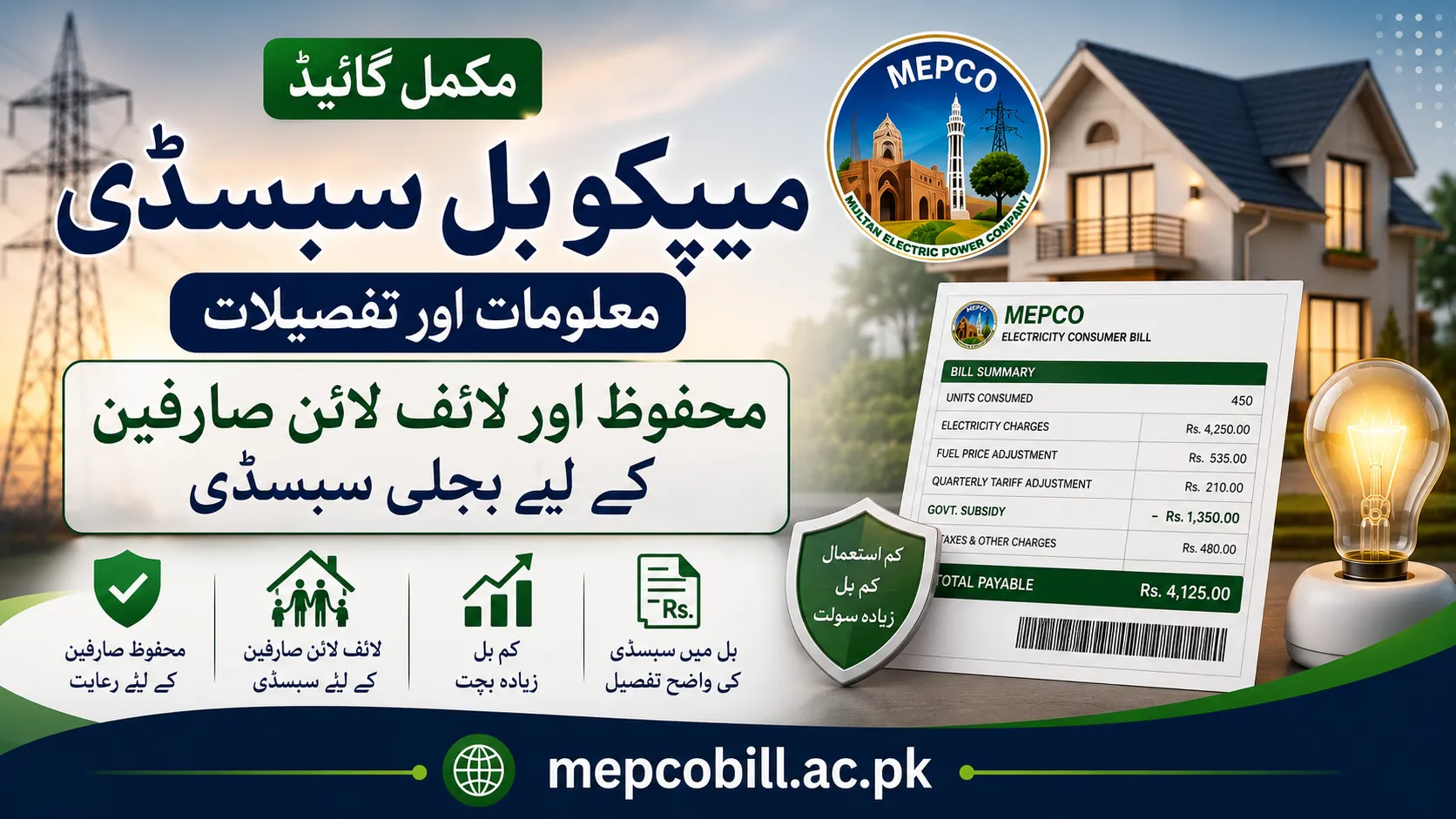
MEPCO Bill Subsidy Guide – Protected & Lifeline Consumer Subsidies Explained
Learn how the MEPCO bill subsidy works for protected and lifeline consumers. Understand eligibility, subsidy concepts, billing, and frequently asked questions in this complete guide.
Complete Guide to Protected and Lifeline Consumer Subsidies
Many electricity consumers notice that two households with similar electricity usage sometimes receive different electricity bills. One of the main reasons is the availability of electricity subsidies for eligible consumers.
If you are a MEPCO customer, you may wonder:
- What is a MEPCO bill subsidy?
- Who qualifies for an electricity subsidy?
- What is a protected consumer?
- Who is considered a lifeline consumer?
- How are subsidies reflected on electricity bills?
- Can a consumer lose subsidy eligibility?
- How can I determine whether my bill includes a subsidy?
This guide answers these questions in simple language. Instead of focusing on temporary government relief packages or changing subsidy amounts, it explains the underlying concepts behind electricity subsidies so the information remains useful over time.
Whether you are checking your MEPCO Online Bill, reviewing your monthly charges, or trying to understand why another household pays less, this guide will help you understand how subsidies fit into Pakistan’s electricity billing system.
What Is a MEPCO Bill Subsidy?
A bill subsidy is financial support that reduces the amount an eligible consumer pays for electricity.
Rather than every consumer paying the full cost of electricity, certain consumer groups may receive assistance through subsidy programs established under the applicable government and regulatory framework.
The purpose of these subsidies is to make electricity more affordable for households that qualify under the relevant eligibility criteria.
In simple terms:
A MEPCO bill subsidy helps eligible consumers pay less for electricity by reducing part of the bill under the applicable subsidy framework.
It is important to understand that MEPCO distributes electricity and issues bills. Subsidy policies and eligibility are determined through the relevant government and regulatory authorities rather than by MEPCO itself.
Why Are Electricity Subsidies Provided?
Electricity is an essential utility for homes, businesses, schools, hospitals, and many other services. Because electricity costs can place a greater burden on lower-consuming households, subsidy programs may be introduced to improve affordability.
The general objectives of electricity subsidies include:
- Supporting lower-income households
- Improving access to essential electricity services
- Reducing the financial burden on eligible residential consumers
- Promoting social welfare
- Helping households manage essential electricity expenses
Subsidies are intended to assist eligible consumer categories rather than all electricity users equally.
Who Can Receive a MEPCO Electricity Subsidy?
Not every electricity consumer receives the same type of subsidy.
Eligibility depends on the applicable billing framework and may consider factors such as:
- Consumer category
- Tariff classification
- Electricity consumption
- Applicable government policies
- Regulatory decisions
Among residential consumers, two of the most commonly discussed categories are:
- Protected Consumers
- Lifeline Consumers
Although these terms are sometimes used interchangeably, they represent different classifications.
What Is a Protected Consumer?
A protected consumer is generally a residential electricity consumer who falls within the eligibility criteria defined under the applicable tariff and regulatory framework.
Protected consumers are intended to receive more favorable billing treatment compared with consumers who fall outside the protected category.
The exact eligibility requirements can change over time, so consumers should always refer to the applicable tariff schedule and official billing information.
Protected consumer status is based on the relevant billing rules rather than a separate application process.
Why Does the Protected Consumer Category Exist?
The protected consumer category is designed to provide additional support to households with relatively lower electricity consumption.
Its purpose is to help reduce the impact of electricity costs on consumers who meet the applicable eligibility criteria.
This classification is one of the ways the electricity billing system differentiates between consumer groups while applying tariffs and subsidies.
Benefits Commonly Associated with Protected Consumers
Depending on the applicable tariff framework, protected consumers may benefit from:
- More favorable residential tariff treatment
- Eligibility for applicable subsidies
- Reduced financial burden compared with higher-consuming households
- Transparent billing based on the applicable tariff category
The specific billing impact depends on the tariff schedule in effect for the relevant billing period.
What Is a Lifeline Consumer?
A lifeline consumer generally refers to a residential consumer with very low electricity consumption who falls within the applicable lifeline category defined under the tariff framework.
The concept exists to help ensure that households with minimal electricity needs can access essential electricity at more affordable rates where applicable.
Because lifeline consumers represent a distinct category, their billing treatment may differ from that of standard residential consumers.
Purpose of the Lifeline Category
The lifeline category is intended to:
- Support households with basic electricity requirements
- Improve affordability for very low electricity users
- Encourage access to essential electricity services
- Provide targeted assistance through the applicable tariff framework
The eligibility thresholds and applicable tariff treatment may change over time, so consumers should consult the latest official tariff information for current details.
Protected Consumer vs. Lifeline Consumer
Although both categories are intended to support eligible residential consumers, they are not identical.
| Feature | Protected Consumer | Lifeline Consumer |
|---|---|---|
| Consumer Type | Residential | Residential |
| Purpose | Support eligible lower-consuming households | Support households with very low electricity usage |
| Eligibility | Based on applicable tariff criteria | Based on applicable lifeline criteria |
| Tariff Treatment | May receive protected tariff benefits | May receive lifeline tariff benefits |
| Subsidy Eligibility | Subject to applicable rules | Subject to applicable rules |
Understanding the distinction helps consumers interpret their electricity bills more accurately.
Does Every Residential Consumer Receive a Subsidy?
No.
Being a residential electricity consumer does not automatically mean that a subsidy applies.
Subsidy eligibility depends on the applicable tariff framework and the consumer’s classification for the relevant billing period.
As electricity usage patterns and tariff classifications change, a consumer’s billing treatment may also change in accordance with the applicable rules.
How Is a Subsidy Reflected on a MEPCO Bill?
When applicable, subsidies are reflected through the billing methodology established under the relevant tariff framework.
Instead of assuming that every bill will contain a separate line labeled “Subsidy,” consumers should review their complete bill, including:
- Tariff Category
- Consumer Classification
- Units Consumed
- Energy Charges
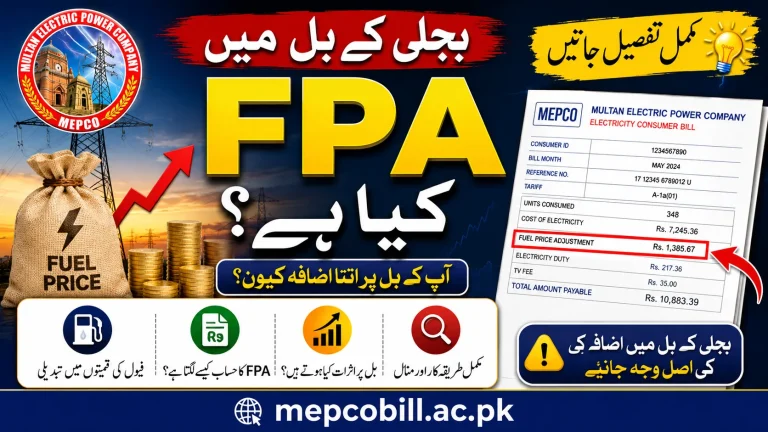
- Fuel Price Adjustment (FPA), where applicable
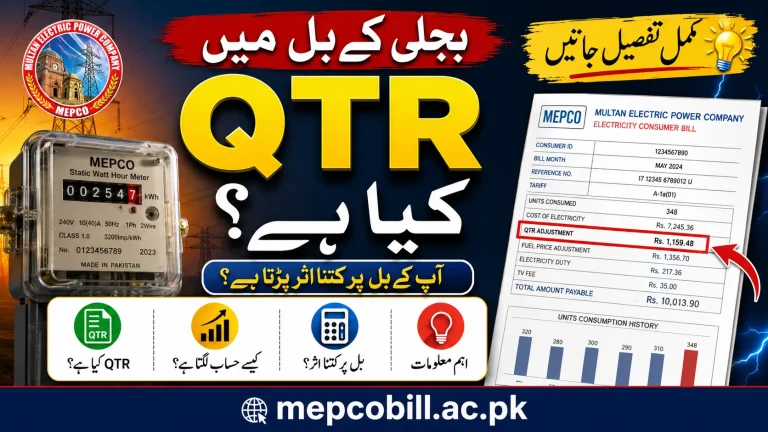
- Quarterly Tariff Adjustment (QTR), where applicable
- Taxes and Other Charges
- Total Payable Amount
Understanding these sections provides better insight into how the final payable amount has been calculated.
Common Misconceptions About Electricity Subsidies
Many consumers misunderstand how subsidies work. Here are some common misconceptions:
“Every residential consumer receives the same subsidy.”
No. Subsidies depend on the applicable tariff framework and eligibility criteria.
“MEPCO decides who receives a subsidy.”
MEPCO issues electricity bills, while subsidy policies are determined under the applicable government and regulatory framework.
“Protected and lifeline consumers are the same.”
No. They are different consumer classifications with different eligibility concepts.
“Subsidies never change.”
Electricity subsidy policies, eligibility rules, and tariff frameworks may change over time. Consumers should rely on the latest official information.
How Is Protected Consumer Status Determined?
One of the most common questions among MEPCO consumers is how a household is classified as a protected consumer. Many people assume that it depends on income, property ownership, or a separate application process. In reality, protected consumer status is generally determined under the applicable electricity tariff and regulatory framework rather than through a manual registration process.
The classification is intended to identify residential consumers who meet the eligibility criteria defined for the relevant billing period. These criteria may be reviewed or updated over time by the relevant authorities, so consumers should always rely on the latest official tariff framework.
Protected consumer status is not a permanent label. It can change if a consumer no longer meets the applicable conditions.
Factors That May Influence Protected Consumer Classification
Although the detailed criteria are established through the applicable tariff framework, several factors may influence how a residential connection is classified.
These commonly include:
- Residential consumer category
- Electricity consumption pattern
- Applicable tariff classification
- Regulatory guidelines
- Billing period
Consumers should remember that classification is based on the applicable billing rules rather than personal requests or applications.
Can Protected Consumer Status Change?
Yes.
Protected consumer status may change if the applicable eligibility conditions are no longer met.
For example, changes in electricity consumption or revisions to the tariff framework may affect how a residential connection is classified for future billing periods.
This is why consumers should periodically review their electricity bills instead of assuming that their classification will always remain the same.
How Does Lifeline Consumer Classification Work?
The lifeline consumer category is intended for households with very low electricity requirements.
Instead of treating every residential consumer identically, the tariff framework may provide a separate classification for consumers whose electricity usage remains within the applicable lifeline criteria.
Because this category is designed to support basic household electricity needs, its billing treatment may differ from that of other residential consumers.
Purpose of the Lifeline Category
The lifeline category exists to help ensure that households with minimal electricity consumption have access to affordable electricity for essential daily needs.
Examples of basic household electricity usage may include:
- Lighting
- Ceiling fans
- Mobile phone charging
- Television
- Small household appliances
The objective is to support essential electricity consumption rather than higher levels of residential electricity use.
Can a Lifeline Consumer Lose Eligibility?
Yes.
If a consumer no longer meets the applicable lifeline criteria, future bills may be issued according to the tariff category that applies under the current billing framework.
Consumers should therefore avoid assuming that lifeline status is permanent.
Protected Consumers vs. Non-Protected Consumers
One of the most important concepts in electricity billing is understanding the difference between protected and non-protected consumers.
These categories help determine how residential electricity consumption is billed under the applicable tariff framework.
Protected Consumers
Protected consumers generally receive billing treatment applicable to consumers who meet the relevant eligibility criteria.
This classification is intended to support households with comparatively lower electricity usage.
Non-Protected Consumers
Residential consumers who do not meet the applicable protected consumer criteria are generally billed according to the tariff structure that applies to non-protected consumers.
This does not necessarily mean that the consumer has done anything wrong. It simply reflects the applicable tariff classification for that billing period.
Key Differences
| Feature | Protected Consumer | Non-Protected Consumer |
|---|---|---|
| Consumer Type | Residential | Residential |
| Tariff Category | Protected | Non-Protected |
| Billing Method | According to protected tariff | According to applicable non-protected tariff |
| Eligibility | Subject to applicable rules | Applies when protected criteria are not met |
| Classification | May change over time | May also change depending on eligibility |
How Subsidies Affect Your Monthly Electricity Bill
Electricity subsidies are intended to reduce the amount eligible consumers pay for electricity.
Rather than reducing every section of the bill individually, the subsidy is reflected through the applicable tariff and billing methodology.
As a result, two households with different classifications may receive different payable amounts even when some billing details appear similar.
Why Two Homes May Receive Different Bills
Consumers often compare their bills with neighbors and notice different payable amounts.
Several factors may contribute to these differences, including:
- Consumer classification
- Tariff category
- Electricity consumption
- Billing period
- Applicable adjustments
- Subsidy eligibility
Looking only at the total payable amount rarely provides the complete picture.
Illustrative Example
Consider two residential consumers:
- Consumer A qualifies under the applicable protected consumer category.
- Consumer B is billed under the applicable non-protected residential category.
Even if both households consume a similar number of electricity units, the final payable amount may differ because each connection is billed according to the tariff framework applicable to its classification.
This example is intended only to illustrate the concept and does not represent actual tariff values.
Relationship Between Subsidies and Electricity Tariffs
Electricity subsidies and tariffs work together but are not the same thing.
A tariff defines how electricity is billed for different categories of consumers.
A subsidy is financial support that may reduce the payable amount for eligible consumers under the applicable framework.
Understanding this distinction helps consumers interpret their bills more accurately.
Why Tariffs Matter
Every electricity bill is prepared according to the tariff category applicable to the connection.
The tariff framework determines how different billing components are applied, including:
- Energy Charges
- Fixed Charges
- Applicable Subsidies
- Fuel Price Adjustment (FPA), where applicable
- Quarterly Tariff Adjustment (QTR), where applicable
How Subsidies Relate to Fuel Price Adjustment (FPA)
Many consumers mistakenly believe that Fuel Price Adjustment is itself a subsidy.
This is incorrect.
Fuel Price Adjustment (FPA) reflects changes in electricity generation fuel costs under the applicable regulatory framework, while a subsidy is financial assistance provided to eligible consumers.
Although both may influence the total payable amount, they serve entirely different purposes.
How Subsidies Relate to Quarterly Tariff Adjustment (QTR)
Quarterly Tariff Adjustment (QTR) is another billing component that is often confused with subsidies.
QTR reflects tariff-related adjustments approved under the applicable regulatory process.
It should not be confused with consumer subsidies, even though both may affect the total bill.
Understanding the difference between subsidies, FPA, and QTR helps consumers read their electricity bills more confidently.
Can Consumers Apply for a Subsidy?
A common misconception is that consumers must submit an application to receive a protected or lifeline subsidy.
In most cases, eligibility is determined according to the applicable tariff and billing framework rather than through a separate subsidy application.
If consumers have questions about their tariff category or billing classification, they should review their electricity bill and contact the relevant customer service channels for clarification.
Best Practices for Consumers
Although consumers cannot directly control tariff classifications or subsidy policies, they can better understand their bills by following a few simple practices:
Review Every Monthly Bill
Check important billing information, including:
- Consumer Number
- Reference Number
- Tariff Category
- Units Consumed
- Energy Charges
- Applicable Adjustments
- Total Payable Amount
Compare Previous Bills
Keeping copies of previous electricity bills helps identify:
- Changes in electricity usage
- Billing trends
- Tariff classification changes
- Seasonal consumption patterns
Understand Every Billing Component
Instead of focusing only on the total payable amount, review each section of the bill to understand how different components contribute to the final amount.
How to Identify Your Consumer Category on a MEPCO Bill
One of the easiest ways to better understand your electricity bill is to review the information printed on it. Your bill contains several important details that help explain how your electricity charges have been calculated.
When reviewing your bill, check the following sections carefully:
- Consumer Number
- Reference Number
- Tariff Category
- Billing Month
- Meter Readings
- Units Consumed
- Energy Charges
- Fuel Price Adjustment (FPA), where applicable
- Quarterly Tariff Adjustment (QTR), where applicable
- Taxes and Other Charges
- Total Payable Amount
Understanding these sections provides better insight into your electricity bill than simply looking at the final payable amount.
Why You Should Review Your Electricity Bill Every Month
Many consumers only check the due date and total payable amount before paying their electricity bill.
However, reviewing your bill each month helps you:
- Monitor electricity consumption
- Compare monthly usage
- Identify changes in billing
- Understand tariff classifications
- Review applicable billing adjustments
- Keep track of your electricity expenses
Regularly reviewing your bill also helps you notice unexpected changes and seek clarification if needed.
Tips for Managing Your Electricity Consumption
Although consumers cannot directly control tariff policies or subsidy frameworks, they can adopt good energy management habits that may help reduce electricity consumption.
Some practical tips include:
- Turn off unnecessary lights and appliances.
- Use energy-efficient LED lighting.
- Choose energy-efficient electrical appliances.
- Avoid unnecessary electricity usage during high-demand periods where practical.
- Regularly maintain electrical equipment.
- Monitor your monthly electricity usage.
- Compare bills to identify consumption trends.
Reducing unnecessary electricity consumption not only lowers energy use but also helps households manage their monthly electricity expenses more effectively.
Frequently Asked Questions (FAQs)
1. What is a MEPCO bill subsidy?
A MEPCO bill subsidy is financial assistance provided under the applicable government and regulatory framework to reduce electricity costs for eligible consumers.
2. Does every residential consumer receive a subsidy?
No. Subsidy eligibility depends on the applicable tariff framework and consumer classification.
3. Who is a protected consumer?
A protected consumer is generally a residential consumer who meets the eligibility criteria defined under the applicable tariff framework.
4. Who is a lifeline consumer?
A lifeline consumer is generally a residential consumer with very low electricity consumption who falls within the applicable lifeline category.
5. Are protected consumers and lifeline consumers the same?
No. They are separate consumer classifications with different purposes and eligibility criteria.
6. Can my consumer classification change?
Yes. Consumer classifications may change depending on the applicable tariff framework and your electricity consumption.
7. Can I apply for protected consumer status?
Protected consumer status is generally determined according to the applicable billing framework rather than through a separate application.
8. Can I apply for a lifeline subsidy?
Eligibility is determined under the applicable tariff framework. Consumers should refer to official guidance for current eligibility rules.
9. Does MEPCO decide subsidy policies?
MEPCO distributes electricity and issues bills. Subsidy policies are established under the applicable government and regulatory framework.
10. Where can I see my tariff category?
Your tariff category is shown on your official MEPCO electricity bill.
11. Does electricity consumption affect subsidy eligibility?
Electricity consumption may influence consumer classification under the applicable tariff framework.
12. Can two households with similar usage receive different bills?
Yes. Consumer classification, tariff category, billing adjustments, and other applicable factors may result in different payable amounts.
13. Is Fuel Price Adjustment (FPA) a subsidy?
No. Fuel Price Adjustment reflects changes in electricity generation fuel costs and is different from an electricity subsidy.
14. Is Quarterly Tariff Adjustment (QTR) a subsidy?
No. Quarterly Tariff Adjustment is a tariff-related billing adjustment and should not be confused with consumer subsidies.
15. Can subsidy rules change?
Yes. Government policies, tariff frameworks, and regulatory decisions may change over time.
16. How can I better understand my electricity bill?
Review your tariff category, units consumed, billing adjustments, taxes, and other billing components instead of focusing only on the total payable amount.
17. Where can I check my MEPCO bill online?
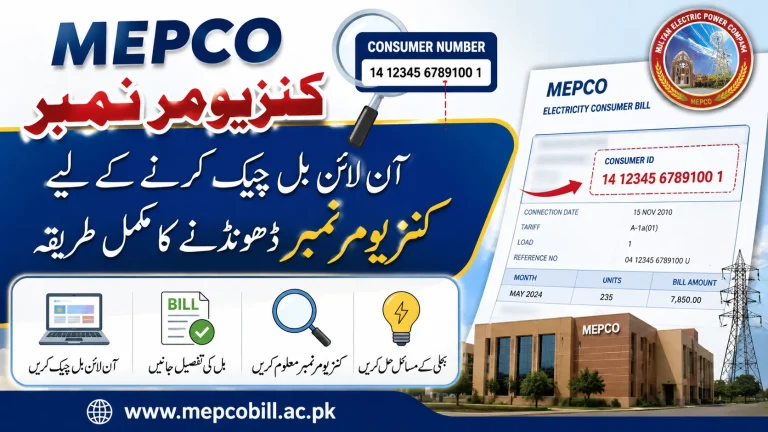
You can check your latest bill using your Consumer Number or Reference Number through the MEPCO online bill service.
18. Can I estimate my electricity bill before it arrives?
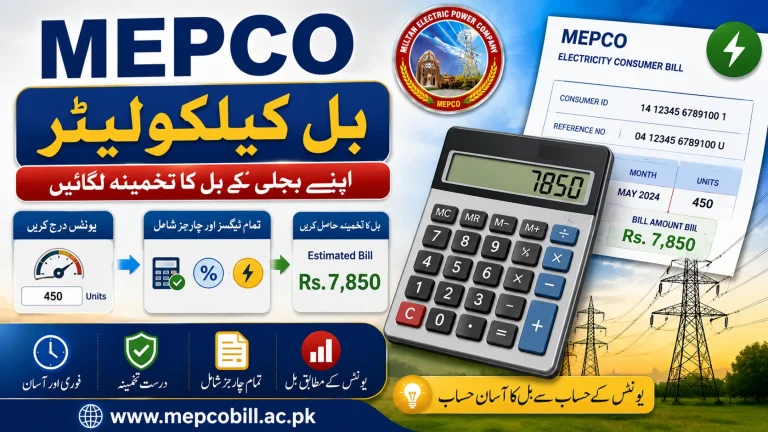
Yes. You can use a MEPCO Bill Calculator to estimate your bill based on expected electricity consumption. Actual charges may differ depending on the applicable billing framework.
19. Why should I keep previous electricity bills?
Previous bills help you compare consumption, review billing history, monitor trends, and keep a record of your electricity usage.
20. Where can I learn more about electricity billing?
Our complete MEPCO knowledge hub includes detailed guides covering electricity bills, tariffs, billing adjustments, payment methods, and consumer information.
Related MEPCO Guides
To better understand every part of your electricity bill, explore these helpful resources:
- MEPCO Online Bill
- MEPCO Duplicate Bill
- Consumer Number Guide
- Reference Number Guide
- MEPCO Bill Calculator
- MEPCO Tariff Guide
- Protected vs. Non-Protected Consumers
- MEPCO Peak Hours Guide
- Electricity Charges Details Guide
- Fuel Price Adjustment (FPA) Guide
- Quarterly Tariff Adjustment (QTR) Guide
- MEPCO Bill Payment Methods
- Electricity Saving Tips
These guides work together to provide a complete understanding of MEPCO electricity billing and consumer services.
Why Understanding Electricity Subsidies Matters
Electricity subsidies play an important role in helping eligible residential consumers manage their electricity expenses. However, many consumers misunderstand how these subsidies work or assume that every household receives the same benefits.
Understanding the difference between protected consumers, lifeline consumers, tariffs, and billing adjustments helps you interpret your electricity bill more accurately and avoid common misconceptions.
Rather than relying on rumors or unofficial information, reviewing your bill and understanding the applicable billing framework provides a much clearer picture of how your electricity charges are calculated.
Summary
Understanding the MEPCO bill subsidy system helps consumers make better sense of their monthly electricity bills. While subsidy eligibility depends on the applicable tariff and regulatory framework, knowing the difference between protected consumers, lifeline consumers, and other residential classifications makes it easier to understand why electricity bills may vary from one household to another.
Throughout this guide, we’ve explained:
- What a MEPCO bill subsidy is
- Why electricity subsidies exist
- Who protected consumers are
- What lifeline consumers are
- How subsidies relate to tariffs
- The difference between subsidies, FPA, and QTR
- How to identify important billing information
- Best practices for reviewing electricity bills
As electricity policies and tariff frameworks may change over time, consumers should always rely on the latest official billing information for current eligibility criteria and tariff details.
Continue Exploring Our MEPCO Knowledge Hub
If you’d like to understand every aspect of your electricity bill, continue exploring our detailed guides.
You can learn how to:
- Check your MEPCO Online Bill
- Download a Duplicate Bill
- Find your Consumer Number
- Locate your Reference Number
- Estimate charges with the MEPCO Bill Calculator
- Understand the MEPCO Tariff Guide
- Learn about Protected vs. Non-Protected Consumers
- Understand Fuel Price Adjustment (FPA)
- Learn about Quarterly Tariff Adjustment (QTR)
- Review Electricity Charges Details
- Explore MEPCO Bill Payment Methods
Our goal is to provide accurate, easy-to-understand, and practical information that helps every MEPCO consumer better understand their electricity bill and related services.