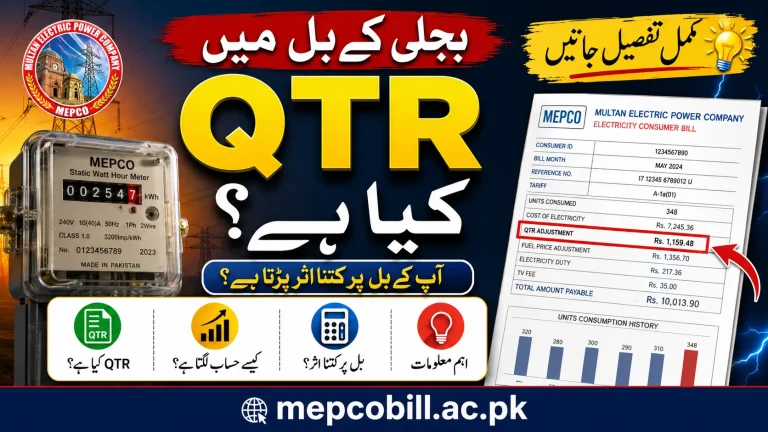

MEPCO Fuel Price Adjustment (FPA) Guide – What is FPA in Electricity Bill?
If you’ve ever carefully reviewed your MEPCO electricity bill, you’ve probably noticed a billing component labeled Fuel Price Adjustment (FPA). Many electricity consumers are surprised to see this charge because it can vary from one billing period to another.
Questions such as:
- What is Fuel Price Adjustment?
- Why is FPA included in my electricity bill?
- Why does the FPA amount change?
- Is FPA charged every month?
- How is Fuel Price Adjustment different from electricity charges?
- Can I avoid paying FPA?
- Why is my FPA higher this month?
are among the most common concerns raised by electricity consumers across Pakistan.
The purpose of this guide is to explain the Fuel Price Adjustment (FPA) in clear, easy-to-understand language. Rather than focusing on technical terminology, we’ll explain the concept, why it exists, how it fits into the electricity billing process, and how it differs from other charges that appear on your monthly bill.
Whether you’re checking your MEPCO online bill, reviewing a duplicate bill, or trying to understand why your electricity bill changed compared to last month, this guide will help you interpret one of the most frequently misunderstood billing components.
What Is Fuel Price Adjustment (FPA)?
Fuel Price Adjustment (FPA) is a billing adjustment that reflects changes in the cost of fuel used to generate electricity.
Electricity is produced using different energy sources. The cost of producing that electricity can change over time because fuel prices, generation sources, and other market conditions do not remain constant throughout the year.
Rather than treating these changing costs as a permanent part of the tariff, they may be reflected through a Fuel Price Adjustment in accordance with the applicable regulatory framework.
In simple terms:
Fuel Price Adjustment is a billing adjustment that reflects changes in electricity generation fuel costs for a particular billing period.
This means the amount shown as FPA can differ from month to month.
Why Does Fuel Price Adjustment Exist?
Electricity generation requires energy resources, and the cost of those resources does not remain fixed.
Over time, factors such as:
- Fuel market prices
- Electricity generation mix
- Supply conditions
- Regulatory decisions
- Operational costs
may influence the overall cost of generating electricity.
Fuel Price Adjustment exists to account for these changes within the applicable billing framework.
Instead of permanently changing the tariff every month, adjustments may be reflected separately on electricity bills where applicable.
Why Is FPA Shown Separately on the Electricity Bill?
Many consumers ask why Fuel Price Adjustment is listed separately instead of being included within electricity charges.
Displaying FPA as a separate billing component improves transparency.
It allows consumers to distinguish between:
- Energy Charges
- Fuel Price Adjustment
- Taxes
- Duties
- Other Regulatory Adjustments
This makes it easier to understand how the final payable amount has been determined.
When reviewing your bill, each billing component serves a specific purpose, and separating them helps consumers identify the factors contributing to the overall cost.
Is Fuel Price Adjustment the Same as Electricity Charges?
No.
This is one of the most common misconceptions among electricity consumers.
Energy Charges and Fuel Price Adjustment are different billing components.
Energy Charges
Energy charges are generally associated with:
- Electricity units consumed
- Applicable tariff category
- Billing framework
These charges represent the cost of electricity usage according to the applicable tariff.
Fuel Price Adjustment
Fuel Price Adjustment reflects changes in electricity generation fuel costs under the applicable regulatory framework.
Unlike energy charges, FPA is an adjustment that may vary between billing periods.
Understanding this distinction helps consumers interpret their electricity bills more accurately.
Why Does the FPA Amount Change Every Month?
One of the most frequently searched questions is:
“Why is my Fuel Price Adjustment different every month?”
The simple answer is that electricity generation costs are not constant.
Several factors may influence Fuel Price Adjustment, including:
- Changes in fuel prices
- Electricity generation sources
- Seasonal demand
- Regulatory decisions
- Billing period
Because these factors change over time, the Fuel Price Adjustment shown on electricity bills may also increase, decrease, or not appear, depending on the applicable billing period.
Is FPA Charged Every Month?
Not necessarily.
The appearance and amount of Fuel Price Adjustment depend on the applicable billing framework and the relevant billing period.
Some bills may contain an FPA entry, while others may differ depending on the regulatory process and billing cycle.
Consumers should always review the official electricity bill for the billing components applicable
How Is Fuel Price Adjustment (FPA) Determined?
After learning what Fuel Price Adjustment is, many consumers naturally ask another important question:
“How is FPA determined?”
The exact methodology used for Fuel Price Adjustment is governed by the applicable regulatory framework and electricity market rules. Rather than being based on a single factor, FPA reflects changes in electricity generation fuel costs during a particular period.
In general, the adjustment is influenced by the difference between fuel-related generation costs used for billing and the applicable benchmark or approved mechanism for that billing period.
Consumers do not need to calculate FPA manually to understand their electricity bill. The important point is that FPA is a variable adjustment, not a fixed monthly charge.
Factors That Can Influence Fuel Price Adjustment
Fuel Price Adjustment can vary because several factors affecting electricity generation change over time.
Some of the key influences include:
1. Changes in Fuel Costs
Electricity can be generated using different fuel sources. If the cost of those fuels changes, electricity generation costs may also change.
2. Electricity Generation Mix
Electricity is produced from multiple energy sources rather than a single fuel.
The proportion of electricity generated from different sources may vary over time, influencing overall generation costs.
3. Seasonal Electricity Demand
Electricity demand changes throughout the year.
For example:
- Summer generally increases cooling-related demand.
- Winter may increase heating-related electricity usage.
- Commercial and industrial activity also affects demand.
Higher or lower demand can influence the overall electricity generation pattern.
4. Regulatory Decisions
Fuel Price Adjustment is applied according to the applicable regulatory framework.
Any approved changes or regulatory decisions affecting electricity generation costs may be reflected through FPA where applicable.
5. Billing Period
Every electricity bill covers a specific billing period.
The Fuel Price Adjustment shown on your bill relates to the applicable rules and generation costs associated with that period.
Does Every Consumer Pay the Same FPA?
Consumers often assume that everyone receives exactly the same Fuel Price Adjustment.
However, the way FPA is reflected on an electricity bill depends on factors such as:
- Consumer category
- Applicable tariff framework
- Billing period
- Regulatory provisions
For this reason, different electricity consumers may not always see identical adjustments on their bills.
Fuel Price Adjustment and Different Consumer Categories
Different categories of electricity consumers have different billing frameworks.
Examples include:
Residential Consumers
Residential consumers use electricity primarily for household purposes.
Their bills generally include billing components applicable to domestic electricity connections.
Commercial Consumers
Businesses such as:
- Shops
- Restaurants
- Offices
- Shopping Centres
- Hotels
often have different electricity usage patterns compared with households.
The applicable billing framework determines how charges, including adjustments, appear on commercial electricity bills.
Industrial Consumers
Industrial consumers typically have higher electricity requirements because of machinery and production processes.
Industrial electricity billing follows the applicable tariff structure for that category.
Agricultural Consumers
Agricultural electricity connections are commonly used for:
- Irrigation Pumps
- Tube Wells
- Farming Operations
Billing for agricultural consumers is determined according to the relevant tariff category and regulatory framework.
Fuel Price Adjustment vs. Energy Charges
Many electricity consumers confuse these two terms.
Although both appear on the electricity bill, they represent different billing concepts.
| Energy Charges | Fuel Price Adjustment (FPA) |
|---|---|
| Related to electricity usage under the applicable tariff | Reflects changes in electricity generation fuel costs |
| One of the main billing components | A separate adjustment when applicable |
| Based on the billing framework and units consumed | Varies according to applicable regulatory provisions and billing period |
| Present on electricity bills as part of energy pricing | Displayed separately for transparency |
Understanding this distinction makes it much easier to interpret your electricity bill.
Fuel Price Adjustment vs. Quarterly Tariff Adjustment (QTR)
Another common source of confusion is the difference between Fuel Price Adjustment (FPA) and Quarterly Tariff Adjustment (QTR).
Although both may appear on electricity bills, they are different adjustments.
| Fuel Price Adjustment (FPA) | Quarterly Tariff Adjustment (QTR) |
|---|---|
| Reflects changes in electricity generation fuel costs | Reflects tariff-related adjustments under the applicable regulatory framework |
| May vary between billing periods | Applied according to the relevant quarterly adjustment process |
| Linked to fuel-related generation costs | Linked to tariff adjustment decisions |
Our dedicated Quarterly Tariff Adjustment (QTR) Guide explains this topic in greater detail.
Can You Calculate FPA Yourself?
Many consumers search for an online FPA Calculator.
In practice, Fuel Price Adjustment is determined under the applicable regulatory framework using official billing processes and approved calculations.
For this reason, consumers generally rely on the amount shown on their official electricity bill rather than calculating it independently.
Instead of trying to calculate FPA manually, it is more useful to understand:
- Why it appears
- Why it changes
- How it differs from other billing components
Common Misconceptions About Fuel Price Adjustment
Several myths circulate about Fuel Price Adjustment.
Let’s clarify some of the most common ones.
Myth 1: FPA Is a Permanent Tax
False.
Fuel Price Adjustment is not simply another tax.
It is a separate billing adjustment associated with changes in electricity generation fuel costs under the applicable framework.
Myth 2: FPA Is the Same Every Month
False.
Fuel Price Adjustment can change from one billing period to another depending on the applicable conditions and regulatory decisions.
Myth 3: Higher Electricity Usage Automatically Means Higher FPA
Electricity usage influences many parts of an electricity bill, but Fuel Price Adjustment is a separate billing component governed by the applicable framework.
Understanding the distinction between energy charges and FPA is important when reviewing your bill.
Myth 4: FPA Appears on Every Bill in Exactly the Same Way
The appearance and application of FPA depend on the relevant billing period and applicable billing rules.
Consumers should always review their official electricity bill for the details specific to their account.
Illustrative Example
Imagine two households:
Household A
- Moderate electricity usage
- Reviews monthly bills regularly
- Understands each billing component
Household B
- Similar electricity usage
- Looks only at the total payable amount
When both households receive their bills, Household A can identify changes in:
- Energy Charges
- Fuel Price Adjustment
- Other Adjustments
while Household B sees only that the total amount has changed.
This example highlights why understanding individual billing components helps consumers interpret their electricity bills more confidently.
How This Guide Complements Other MEPCO Resources
Fuel Price Adjustment is only one part of your electricity bill.
For a complete understanding of electricity billing, explore these related guides:
- MEPCO Electricity Charges Explained
- MEPCO Tariff Guide
- MEPCO Bill Calculator
- MEPCO Peak Hours
- Quarterly Tariff Adjustment (QTR) Guide
- Consumer Number Guide
- Reference Number Guide
Together, these resources explain every major section of an electricity bill and help consumers understand how different billing components work together.
How to Review Fuel Price Adjustment (FPA) on Your Electricity Bill
When you receive your monthly MEPCO electricity bill, it is good practice to review each billing component instead of focusing only on the total payable amount.
Understanding where the Fuel Price Adjustment (FPA) appears on your bill helps you identify changes from one billing period to another and better understand the factors contributing to your electricity charges.
When reviewing your bill, check the following information:
- Customer Name
- Consumer Number
- Reference Number
- Billing Month
- Previous Meter Reading
- Current Meter Reading
- Units Consumed
- Tariff Category
- Energy Charges
- Fuel Price Adjustment (FPA)
- Quarterly Tariff Adjustment (QTR), if applicable
- Taxes and Government Levies
- Other Adjustments
- Due Date
- Total Payable Amount
Reviewing each section provides a clearer picture of your electricity bill than looking only at the final amount.
Tips for Better Understanding Fuel Price Adjustment
Although consumers cannot directly control Fuel Price Adjustment, understanding how it works makes electricity bills much easier to interpret.
Compare Bills from Different Months
Instead of reviewing only your latest bill, compare it with previous months.
This allows you to observe:
- Changes in electricity units
- Variations in energy charges
- Differences in Fuel Price Adjustment
- Seasonal electricity consumption
- Overall billing trends
Keeping digital copies of previous bills makes these comparisons much easier.
Understand Every Billing Component
Fuel Price Adjustment is only one part of your electricity bill.
To fully understand your monthly charges, also review:
- Energy Charges
- Fixed Charges
- Taxes
- Duties
- Quarterly Tariff Adjustment (QTR)
- Other Billing Adjustments
- Reading the bill as a whole provides much better context.
Use the Bill Calculator for Estimates
If you want to estimate future electricity costs, use our MEPCO Bill Calculator.
While the calculator estimates electricity costs based on consumption, your official bill remains the authoritative record of all applicable billing components.
Stay Informed About Tariff Concepts
Many billing terms are connected.
Understanding:
- Tariff Categories
- Peak Hours
- Fuel Price Adjustment
- Quarterly Tariff Adjustment
- Electricity Charges
helps you interpret electricity bills more confidently.
Frequently Asked Questions
1. What is Fuel Price Adjustment (FPA)?
Fuel Price Adjustment is a billing adjustment that reflects changes in electricity generation fuel costs under the applicable regulatory framework.
2. Why does FPA appear on my electricity bill?
FPA may appear to reflect changes in fuel-related electricity generation costs for the applicable billing period.
3. Why is my FPA different every month?
Fuel Price Adjustment can change because electricity generation costs, billing periods, and regulatory decisions may vary over time.
4. Is FPA a tax?
No.
Fuel Price Adjustment is a billing adjustment and should not be confused with government taxes or duties.
5. Is FPA included in electricity units?
No.
Electricity units represent your consumption, while Fuel Price Adjustment is a separate billing component.
6. Can I remove FPA from my electricity bill?
Fuel Price Adjustment is applied according to the applicable billing framework where relevant. Consumers should refer to their official bill for the billing components that apply.
7. Is FPA charged every month?
Its appearance and amount depend on the applicable billing period and regulatory framework.
8. Does everyone receive the same FPA?
The way Fuel Price Adjustment is reflected on electricity bills depends on factors such as the applicable tariff framework, consumer category, and billing period.
9. Is FPA the same as QTR?
No.
Fuel Price Adjustment and Quarterly Tariff Adjustment are different billing adjustments with different purposes.
10. Why should I compare previous bills?
Comparing previous bills helps identify:
- Seasonal electricity usage
- Billing changes
- Variations in Fuel Price Adjustment
- Long-term consumption patterns
11. Can I calculate Fuel Price Adjustment myself?
Consumers generally rely on the official amount shown on their electricity bill because FPA is determined under the applicable regulatory framework.
12. Does higher electricity consumption always mean higher FPA?
Fuel Price Adjustment is separate from energy charges. Your electricity usage affects energy consumption, while FPA is determined according to the applicable billing framework.
13. Where can I learn more about electricity tariffs?
Our MEPCO Tariff Guide explains electricity tariffs, consumer categories, and billing concepts in detail.
14. What is the difference between Energy Charges and FPA?
Energy Charges are associated with electricity consumption under the applicable tariff, while Fuel Price Adjustment reflects changes in electricity generation fuel costs.
15. Where can I understand every charge on my electricity bill?
Our MEPCO Electricity Charges Explained guide provides a complete breakdown of every major billing component.
16. Does weather affect Fuel Price Adjustment?
Weather can influence electricity demand and the broader electricity generation environment, but Fuel Price Adjustment is determined under the applicable regulatory framework rather than weather alone.
17. Can businesses also receive Fuel Price Adjustment?
Different consumer categories are billed according to the applicable tariff framework. The official bill reflects the billing components that apply to the specific connection.
18. Why should I save my electricity bills?
Previous bills help you compare electricity usage, review billing history, locate your Consumer Number and Reference Number, and organize your utility records.
19. Can I estimate my electricity bill before it arrives?
Yes.
Our MEPCO Bill Calculator helps estimate electricity costs based on expected electricity consumption. Actual bills may differ because of applicable adjustments and billing components.
20. Where can I learn more about electricity billing?
Explore our complete knowledge center, including:
- MEPCO Online Bill
- MEPCO Duplicate Bill
- Consumer Number Guide
- Reference Number Guide
- Bill Calculator
- Tariff Guide
- Peak Hours Guide
- Electricity Charges Explained
- Quarterly Tariff Adjustment (QTR) Guide
- Electricity Saving Tips
Related MEPCO Guides
Continue learning with our comprehensive electricity billing resources:
- MEPCO Duplicate Bill
- MEPCO Consumer Number Guide
- MEPCO Reference Number Guide
- MEPCO Bill Calculator
- MEPCO Tariff Guide
- MEPCO Peak Hours Guide
- MEPCO Electricity Charges Explained
- Quarterly Tariff Adjustment (QTR) Guide
- Protected vs. Non-Protected Consumers
- Electricity Saving Tips
- Online Bill Payment Methods
These guides are designed to answer common questions and help you understand every section of your electricity bill.
Why Understanding Fuel Price Adjustment Is Important
Fuel Price Adjustment is one of the most frequently misunderstood items on an electricity bill. Many consumers notice the charge but are unsure why it appears or why it changes.
This guide has explained:
- What Fuel Price Adjustment is
- Why it appears on electricity bills
- Why it changes over time
- How it differs from Energy Charges
- The factors that influence it
- How it compares with Quarterly Tariff Adjustment
- Best practices for reviewing your electricity bill
By understanding these concepts, you’ll be better equipped to interpret your monthly bill and understand why different billing components contribute to the final payable amount.
Conclusion
Fuel Price Adjustment (FPA) is an important part of the electricity billing process because it reflects changes in electricity generation fuel costs under the applicable regulatory framework. While the amount may vary between billing periods, understanding its purpose helps consumers read their electricity bills with greater confidence.
Rather than focusing solely on the total payable amount, reviewing individual billing components—such as Energy Charges, Fuel Price Adjustment, Quarterly Tariff Adjustment, taxes, and other adjustments—provides a clearer picture of how the bill is structured.
Combined with our MEPCO Tariff Guide, Electricity Charges Explained, and MEPCO Bill Calculator, this guide forms part of a complete educational resource designed to help consumers understand every aspect of their electricity bill.
Continue Exploring Your Electricity Bill
Now that you understand Fuel Price Adjustment (FPA), continue learning about the other important parts of your electricity bill.
Our goal is to make electricity billing easier to understand by providing accurate, practical, and easy-to-follow information for every MEPCO consumer.