
MEPCO Electricity Charges Explained – Complete Guide to Every Bill Component
When your monthly electricity bill arrives, you’ll notice that it contains much more than just the number of units you consumed. Along with your energy charges, there are several other billing components that contribute to the final amount payable.
Many consumers ask questions such as:
- Why is my electricity bill higher than expected?
- What are energy charges?
- Why are taxes shown separately?
- What is Fuel Price Adjustment (FPA)?
- What is Quarterly Tariff Adjustment (QTR)?
- Why are there additional charges on my bill?
- How is the total payable amount calculated?
This comprehensive guide explains every major section of a typical MEPCO electricity bill in simple language. By understanding each component, you’ll be better equipped to read your bill, compare monthly charges, and understand the factors that influence your electricity costs.
Whether you’re checking your latest bill, downloading a duplicate bill, or estimating future expenses with our MEPCO Bill Calculator, this guide will help you understand what you’re looking at.
Why Understanding Electricity Charges Is Important
Many consumers focus only on the Total Payable Amount.
However, each line on your electricity bill provides useful information about your electricity connection, consumption, billing period, and applicable charges.
Understanding these sections helps you:
- Read your electricity bill confidently.
- Compare current and previous bills.
- Understand why monthly bills change.
- Verify important billing information.
- Identify unusual changes in electricity consumption.
- Learn how electricity usage relates to billing.
Rather than viewing your bill as a single amount due, you’ll understand how different billing components work together.
How an Electricity Bill Is Generally Calculated
Although the exact billing process depends on the applicable tariff framework and regulatory rules, a typical electricity bill is based on several key elements.
These commonly include:
- Electricity units consumed
- Consumer category
- Applicable tariff
- Energy charges
- Fixed charges (where applicable)
- Fuel Price Adjustment (FPA), if applicable
- Quarterly Tariff Adjustment (QTR), if applicable
- Taxes and government levies
- Other approved adjustments shown on the official bill
These components together determine the final payable amount shown on your bill.
Understanding the Main Sections of Your Electricity Bill
A typical electricity bill contains several sections that provide information about your account and billing period.
Let’s examine each one.
Customer Information
The upper portion of the bill usually contains customer identification details.
These may include:
- Customer Name
- Service Address
- Consumer Number
- Reference Number
- Tariff Category
- Billing Month
Always verify these details before reviewing the charges.
If any information appears incorrect, it should be investigated through the appropriate customer support channels.
Consumer Number
The Consumer Number uniquely identifies your electricity connection.
It is commonly used to:
- Check your electricity bill online
- Retrieve account information
- Download duplicate bills
- Verify electricity connection details
Our dedicated Consumer Number Guide explains where to find this number and how to use it.
Reference Number
The Reference Number is another important identifier printed on your electricity bill.
It is frequently used when:
- Checking bills online
- Downloading duplicate bills
- Retrieving billing records
- Making bill payments through supported channels
Although it appears alongside the Consumer Number, the two numbers serve different purposes.
For a detailed explanation, see our Reference Number Guide.
Billing Month
Every electricity bill relates to a specific billing period.
Reviewing the billing month helps you:
- Compare monthly electricity usage.
- Track seasonal changes.
- Organize billing records.
Keeping previous bills makes long-term comparisons much easier.
Meter Readings
Meter readings are used to determine the amount of electricity consumed during the billing period.
A bill generally displays:
- Previous Meter Reading
- Current Meter Reading
- Reading Date
The difference between these readings represents the electricity used during the billing cycle.
Monitoring meter readings can help you understand changes in electricity usage over time.
Units Consumed
Electricity consumption is measured in kilowatt-hours (kWh), commonly referred to as units.
Every appliance contributes to your monthly unit consumption.
Examples include:
- Air Conditioners
- Refrigerators
- Water Pumps
- Electric Geysers
- Ceiling Fans
- Lighting
- Washing Machines
- Televisions
- Kitchen Appliances
Generally, higher unit consumption results in higher energy charges.
Tracking your units every month helps identify seasonal patterns and changes in electricity usage.
Tariff Category
Your electricity connection belongs to a tariff category based on the applicable billing framework.
Common categories include:
- Residential
- Commercial
- Industrial
- Agricultural
- Public Sector
Different categories may be subject to different billing rules.
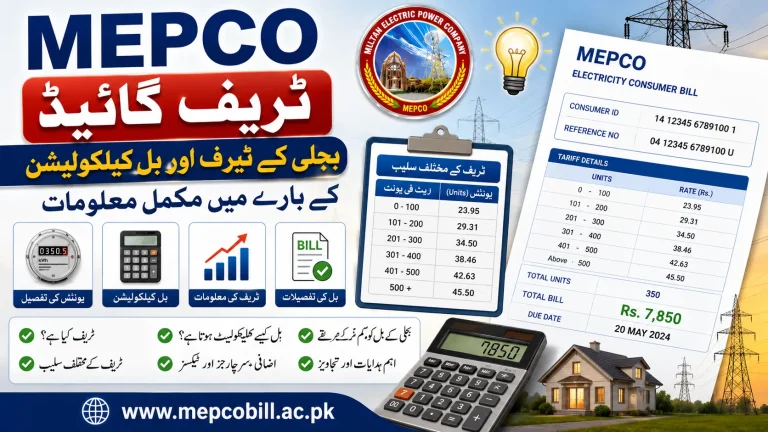
Our MEPCO Tariff Guide explains tariff categories in detail.
Energy Charges
Energy charges are one of the largest components of an electricity bill.
These charges are generally linked to:
- Electricity units consumed
- Applicable tariff category
- Billing rules for the relevant period
As electricity consumption increases or decreases, energy charges usually change as well.
For example, households often experience higher energy charges during summer because cooling appliances operate for longer periods.
Why Energy Charges Change
Energy charges do not remain constant every month.
They may vary because of:
- Changes in electricity usage
- Seasonal weather
- Addition of new electrical appliances
- Increased operating hours
- Consumer category
- Applicable tariff framework
Comparing several months of bills can help you understand these patterns.
Examples of High-Consumption Appliances
Some appliances contribute more significantly to electricity usage.
These include:
- Air Conditioners
- Electric Heaters
- Electric Geysers
- Water Pumps
- Electric Ovens
- Deep Freezers
Moderate-consumption appliances include:
- Refrigerators
- Washing Machines
- Microwave Ovens
Lower-consumption devices include:
- LED Bulbs
- Wi-Fi Routers
- Mobile Chargers
- LED Televisions
Understanding appliance usage helps explain changes in monthly unit consumption.
Fixed Charges
Some electricity bills may include fixed charges.
Unlike energy charges, fixed charges are generally not directly based on the number of electricity units consumed.
Instead, they relate to the electricity connection and the applicable tariff framework.
The presence and calculation of fixed charges depend on the applicable billing rules and consumer category.
Because billing policies may change over time, always refer to your official bill for the charges that apply to your connection.
Variable Charges
Variable charges are those that change according to electricity usage or other applicable billing components.
Examples may include:
- Energy charges
- Usage-related adjustments
- Certain regulatory adjustments
Since these charges can change from month to month, they often explain why the total payable amount varies even when household routines seem similar.
Understanding the Relationship Between Units and Charges
One of the most important concepts for electricity consumers is the relationship between electricity usage and billing.
In simple terms:
- Your meter records electricity usage.
- Usage is measured in units (kWh).
- Units are considered within the applicable tariff framework.
- Billing components are then applied according to the official billing process.
- The result is your total payable amount.
Understanding this process makes your electricity bill much easier to interpret.
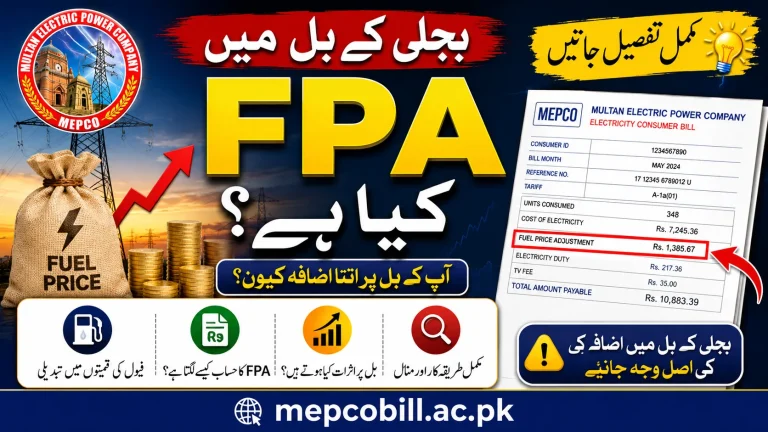
Fuel Price Adjustment (FPA) Explained
One of the most frequently asked questions from electricity consumers is:
“What is Fuel Price Adjustment (FPA) on my electricity bill?”
Fuel Price Adjustment (FPA) is a billing component that reflects changes in electricity generation fuel costs under the applicable regulatory framework.
Because fuel prices can change over time, this adjustment may also vary from one billing period to another.
For this reason, you may notice that the FPA amount shown on one month’s bill is different from the amount shown on another month’s bill.
Why Does FPA Change?
Several factors can influence this adjustment, including:
- Changes in electricity generation costs
- Regulatory decisions
- Billing period
- Applicable consumer category
Consumers should remember that FPA is not a fixed amount.
Instead, it is an adjustment that may increase, decrease, or not appear depending on the applicable billing period and regulatory framework.
For a complete explanation, read our dedicated Fuel Price Adjustment (FPA) Guide.
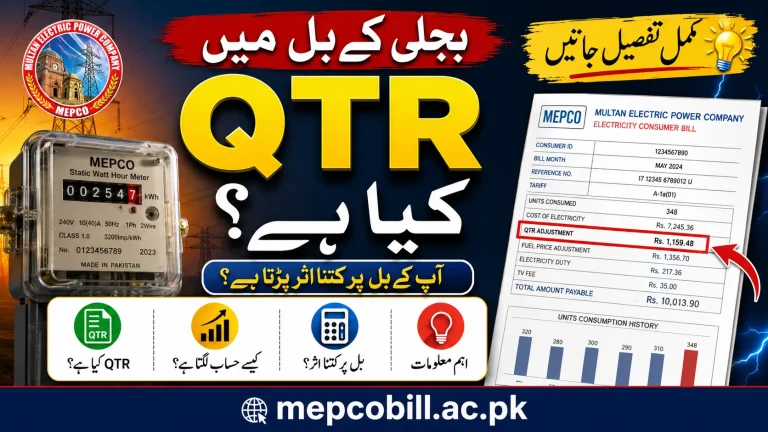
Quarterly Tariff Adjustment (QTR) Explained
Another component that often causes confusion is the Quarterly Tariff Adjustment (QTR).
Quarterly Tariff Adjustment is a regulatory billing adjustment that may appear on electricity bills depending on the applicable rules and billing period.
Like FPA, it is not a permanent monthly charge.
Instead, it may appear only when applicable.
Why Does QTR Exist?
Electricity tariffs are reviewed periodically under the applicable regulatory process.
When required, adjustments may be reflected through the Quarterly Tariff Adjustment.
Our dedicated Quarterly Tariff Adjustment (QTR) Guide explains:
- What QTR means
- Why it appears
- How it differs from FPA
- Common consumer questions
Taxes on Electricity Bills
Electricity bills may include taxes or government levies that are applicable under current laws and regulations.
These items are usually displayed separately to improve billing transparency.
Depending on the applicable rules and consumer category, your bill may include one or more tax-related entries.
Examples include:
- Sales Tax (where applicable)
- Electricity Duty
- Other Government Levies
The exact taxes shown on your bill depend on the billing period and applicable regulations.
Because tax policies may change, always refer to your official bill for the current details.
Electricity Duty
Electricity Duty is a government levy that may appear on electricity bills where applicable.
Like other tax-related components, it is shown separately so consumers can understand how the final payable amount has been calculated.
Sales Tax
Depending on applicable regulations, electricity bills may include sales tax.
The applicable tax treatment depends on current government policies and may vary over time.
Rather than memorizing individual tax amounts, consumers should focus on understanding where these items appear on the bill and how they contribute to the total payable amount.
Other Government Charges
Some electricity bills may include additional government-authorized charges depending on the applicable billing framework.
Examples include:
- Regulatory Levies
- Government Duties
- Approved Adjustments
Not every electricity bill will contain every possible charge.
The exact billing components depend on the consumer category, billing period, and applicable regulations.
Arrears
If there is any outstanding amount from a previous billing period, it may appear as Arrears on the current electricity bill.
Arrears represent unpaid amounts carried forward from earlier bills.
Reviewing this section helps consumers understand whether any previous balance has been added to the current bill.
Adjustments
Sometimes electricity bills include adjustments related to previous billing periods.
Examples may include:
- Billing Corrections
- Approved Adjustments
- Regulatory Adjustments
These items are generally shown separately to maintain billing transparency.
Late Payment Surcharge
If a previous electricity bill was not paid by the due date, a late payment surcharge may apply according to the applicable billing rules.
The exact application depends on the official billing policy.
Reviewing your due date carefully can help you avoid unnecessary additional charges.
How the Total Payable Amount Is Determined
Many consumers immediately look at the Total Payable Amount without reviewing the individual billing components.
The total payable amount generally represents the combined result of:
- Energy Charges
- Fixed Charges (where applicable)
- Fuel Price Adjustment (FPA)
- Quarterly Tariff Adjustment (QTR)
- Taxes and Government Levies
- Other Approved Charges
- Previous Arrears (if any)
- Applicable Adjustments
Because several components contribute to the final amount, reviewing each section provides a much better understanding of your electricity bill.
Sample Electricity Bill Breakdown
Although every electricity bill is unique, a simplified billing structure typically includes:
Customer Information
        │
        ▼
Meter Readings
        │
        ▼
Units Consumed
        │
        ▼
Tariff Category
        │
        ▼
Energy Charges
        │
        ▼
Fixed Charges
        │
        ▼
Fuel Price Adjustment (FPA)
        │
        ▼
Quarterly Tariff Adjustment (QTR)
        │
        ▼
Taxes & Duties
        │
        ▼
Other Adjustments
        │
        ▼
Total Payable Amount
This illustration helps consumers understand how multiple billing components contribute to the final amount.
Common Reasons Electricity Bills Increase
Many consumers become concerned when they receive a higher-than-expected electricity bill.
Several factors can contribute to increased electricity costs.
Higher Electricity Consumption
Using more electricity naturally results in greater energy charges.
This often occurs because of:
- Increased air-conditioner usage
- Additional household appliances
- Longer operating hours
- More family members at home
Seasonal Changes
Summer generally increases cooling-related electricity usage.
Winter may increase heating-related electricity consumption.
Seasonal weather is one of the most common reasons electricity bills vary throughout the year.
New Electrical Appliances
Purchasing additional appliances may increase monthly electricity consumption.
Examples include:
- Air Conditioners
- Electric Water Heaters
- Deep Freezers
- Water Pumps
Monitoring new appliance usage helps explain changes in monthly bills.
Billing Adjustments
Official bills may include approved adjustments related to the applicable billing framework.
These adjustments can influence the final payable amount.
Changes in Applicable Tariffs
Electricity tariffs may change according to the relevant regulatory process.
When tariff structures change, electricity bills may also change.
Our MEPCO Tariff Guide explains these concepts in greater detail.
How to Verify Your Electricity Bill
Reviewing your bill carefully each month helps ensure the information appears reasonable.
Check:
- Customer Name
- Consumer Number
- Reference Number
- Billing Month
- Meter Readings
- Units Consumed
- Tariff Category
- Energy Charges
- Additional Billing Components
- Total Payable Amount
Keeping previous bills makes comparisons much easier.
How the Bill Calculator Complements This Guide
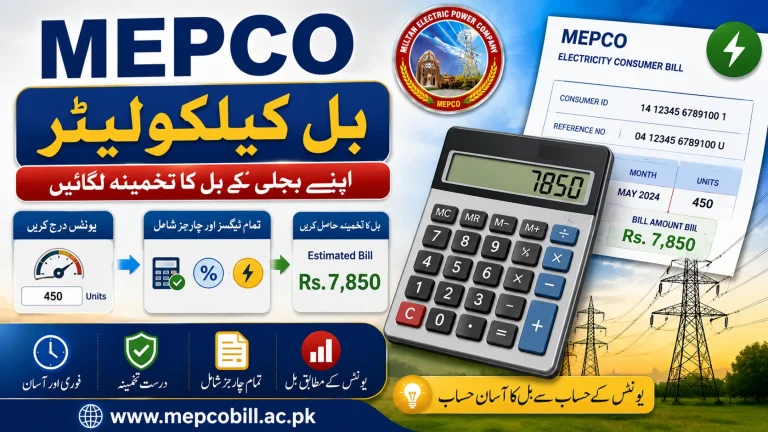
Our MEPCO Bill Calculator helps estimate electricity costs based on your expected electricity usage.
This guide explains:
- Why electricity bills contain multiple charges
- What each billing component means
- Why estimates and official bills may differ
- How billing information is organized
Together, the calculator and this guide help consumers better understand their electricity expenses.
How to Review Your Electricity Bill Every Month
Many consumers only look at the Total Payable Amount before paying their electricity bill. However, reviewing the complete bill each month helps you understand your electricity consumption, identify unusual changes, and keep accurate household or business records.
A good habit is to compare your current bill with the previous two or three months.
Before making a payment, review the following:
- Customer Name
- Consumer Number
- Reference Number
- Billing Month
- Previous Meter Reading
- Current Meter Reading
- Units Consumed
- Tariff Category
- Energy Charges
- Fuel Price Adjustment (FPA)
- Quarterly Tariff Adjustment (QTR)
- Taxes and Duties
- Other Adjustments
- Due Date
- Total Payable Amount
Taking a few minutes to review these details can help you better understand changes in your electricity bill.
Practical Tips to Better Understand Your Electricity Charges
Understanding electricity charges becomes easier when you build a few simple habits.
Compare Bills Every Month
Keeping previous bills allows you to compare:
- Electricity units
- Billing periods
- Energy charges
- Seasonal changes
- Overall electricity consumption
This helps identify patterns rather than focusing on a single month’s bill.
Monitor High-Energy Appliances
Some appliances contribute more significantly to electricity usage than others.
Examples include:
- Air Conditioners
- Electric Geysers
- Electric Heaters
- Water Pumps
- Refrigerators
- Deep Freezers
- Washing Machines
- Electric Ovens
Being aware of how often these appliances are used can help explain differences in monthly electricity consumption.
Save Digital Copies of Bills
Downloading and saving PDF copies of your monthly electricity bills makes it easier to:
- Review previous billing periods
- Compare consumption trends
- Locate your Consumer Number
- Find your Reference Number
- Maintain organized utility records
Understand Before You Compare
Many consumers compare only the total amount payable.
Instead, compare:
- Units consumed
- Billing month
- Energy charges
- Applicable adjustments
- Total payable amount
Looking at the complete bill provides a more accurate understanding of why your electricity costs may have changed.
Frequently Asked Questions
1. What are MEPCO electricity charges?
MEPCO electricity charges refer to the different billing components shown on an electricity bill, including energy charges, applicable adjustments, taxes, duties, and other approved billing items.
2. Why is my electricity bill different every month?
Electricity bills may change because of:
- Different electricity usage
- Seasonal appliance use
- Billing period variations
- Applicable tariff changes
- Fuel Price Adjustment (FPA)
- Quarterly Tariff Adjustment (QTR)
- Taxes and other billing components
3. What are energy charges?
Energy charges are one of the primary components of an electricity bill and are generally related to electricity consumption under the applicable tariff framework.
4. What are fixed charges?
Fixed charges are billing components that are generally not directly linked to the number of electricity units consumed. Their application depends on the applicable tariff rules and consumer category.
5. What is Fuel Price Adjustment (FPA)?
Fuel Price Adjustment (FPA) is a billing adjustment that reflects changes in electricity generation fuel costs under the applicable regulatory framework.
6. What is Quarterly Tariff Adjustment (QTR)?
Quarterly Tariff Adjustment (QTR) is a regulatory adjustment that may appear on electricity bills depending on the applicable billing period and rules.
7. Why do taxes appear separately on my electricity bill?
Taxes and government levies are generally listed separately to improve billing transparency and show how the final payable amount has been calculated.
8. What are arrears?
Arrears represent unpaid amounts carried forward from previous billing periods.
9. What are billing adjustments?
Billing adjustments are corrections or regulatory changes that may be applied to an electricity bill when applicable.
10. Why is the Total Payable Amount higher than my energy charges?
The total payable amount may include:
- Energy Charges
- Fixed Charges
- Fuel Price Adjustment (FPA)
- Quarterly Tariff Adjustment (QTR)
- Taxes
- Duties
- Arrears
- Other approved billing adjustments
11. How can I estimate my electricity bill?
You can use our MEPCO Bill Calculator to estimate electricity costs based on your expected unit consumption.
12. Where can I find my Consumer Number?
Your Consumer Number is printed on your electricity bill.
Our Consumer Number Guide explains where to locate it and how to use it.
13. Where can I find my Reference Number?
Your Reference Number is also printed on your electricity bill.
See our Reference Number Guide for detailed instructions.
14. How do I understand my tariff category?
Your tariff category appears on your electricity bill and determines the applicable billing framework for your electricity connection.
Our MEPCO Tariff Guide explains this topic in detail.
15. Can I reduce my electricity charges?
Monitoring electricity usage, using energy-efficient appliances, and reviewing your monthly consumption can help you better manage electricity costs over time.
16. Why should I compare previous electricity bills?
Comparing previous bills helps identify:
- Seasonal trends
- Consumption changes
- Billing differences
- Long-term electricity usage
17. Are all electricity bills the same?
No.
Billing components may vary depending on the consumer category, billing period, and applicable regulations.
18. Why should I save my monthly electricity bills?
Previous bills provide a useful record for:
- Budget planning
- Consumption analysis
- Account verification
- Utility record keeping
19. How can I better understand my electricity bill?
Review the bill section by section instead of focusing only on the total payable amount. Understanding each billing component makes it easier to interpret your monthly charges.
20. Where can I learn more about electricity billing?
Our website provides comprehensive guides covering:
- MEPCO Online Bill
- Duplicate Bill
- Consumer Number
- Reference Number
- Tariff Guide
- Peak Hours
- Fuel Price Adjustment (FPA)
- Quarterly Tariff Adjustment (QTR)
- Bill Calculator
- Electricity Saving Tips
Related MEPCO Guides
Continue exploring our electricity knowledge center:
- MEPCO Online Bill
- MEPCO Duplicate Bill
- MEPCO Consumer Number Guide
- MEPCO Reference Number Guide
- MEPCO Bill Calculator
- MEPCO Tariff Guide
- MEPCO Peak Hours
- Fuel Price Adjustment (FPA) Guide
- Quarterly Tariff Adjustment (QTR) Guide
- Protected vs. Non-Protected Consumers
- Electricity Saving Tips
- Online Bill Payment Methods
These guides work together to explain every important part of electricity billing and account management.
Why This Guide Matters
Most consumers only interact with their electricity bill once a month. Without understanding the different charges, it can be difficult to know why the total amount changes or what each billing component represents.
This guide has explained:
- Customer information
- Consumer Number
- Reference Number
- Meter readings
- Units consumed
- Energy charges
- Fixed charges
- Fuel Price Adjustment (FPA)
- Quarterly Tariff Adjustment (QTR)
- Taxes and duties
- Other billing adjustments
- Total payable amount
By understanding these components, you can read your electricity bill with greater confidence and make more informed decisions about your electricity usage.
Conclusion
Your electricity bill contains far more information than just the amount you need to pay. Each section—from meter readings and units consumed to energy charges, adjustments, and taxes—plays a role in explaining how the final amount has been determined.
Learning what these billing components mean allows you to:
- Interpret your monthly bill more confidently.
- Compare electricity usage over time.
- Understand why bills increase or decrease.
- Use estimation tools more effectively.
- Maintain better household or business utility records.
As you continue exploring our knowledge center, you’ll find detailed guides dedicated to each billing concept so you can build a complete understanding of your electricity account.
Explore More Electricity Billing Guides
Now that you understand the major electricity bill components, continue learning with our in-depth resources.
Our mission is to make electricity billing easier to understand by providing clear explanations, practical tools, and reliable educational resources for every MEPCO consumer.